
There is probably no faster way to discover a problem with your school’s facility scheduling process than having two groups arrive at the same gym, field, classroom, or auditorium at the same time.
Maybe the athletic department had the gym on its schedule. The facilities office approved a community rental. A coach thought the practice time had already been confirmed. Somewhere between a shared calendar, an email chain, a spreadsheet, and a conversation in the hallway, two different groups walked away believing they had the same space.
For many schools, that is not an unusual situation. It is a sign that the process has outgrown the tools being used to manage it.
Facility scheduling software for schools gives K–12 schools and districts a centralized way to manage how facilities are requested, approved, reserved, and used. Instead of relying on disconnected calendars, spreadsheets, paper forms, emails, and individual staff members to keep everything coordinated, schools can manage facility availability and reservations through one system.
That matters because school buildings are no longer used only during the school day. Athletic programs, clubs, community organizations, performing arts, camps, meetings, outside rentals, and special events all compete for the same spaces.
The more people who need those facilities, the more important it becomes to have one reliable source of truth.
Alphacility is facility scheduling software built specifically for schools and districts, bringing facility requests, approvals, bookings, community rentals, payments, availability, and usage information into one connected platform.
Why School Facility Scheduling Gets Complicated
At first glance, scheduling a school facility seems simple. Find an open space, choose a date and time, and put it on the calendar.
The problem is that the calendar is only one part of the process.
A high school gym might be needed for basketball practice at 3:30, a school event at 6:00, and a community organization later that evening. The auditorium may have a rehearsal scheduled while another department is planning a parent event. Athletic fields may need to accommodate games, practices, camps, maintenance, and outside organizations throughout the same week.
Every reservation can also involve different people.
Athletic directors are managing practices and competitions. Principals and administrators are overseeing building use. Facilities and operations teams need to know when spaces are occupied and whether setup or teardown is required. Community-use coordinators may be processing outside rental requests. District leadership may need visibility across several schools.
The problem becomes even more difficult when each group maintains its own information.
Athletics may use one calendar. Facilities may use another. Outside rental requests may arrive by email. A spreadsheet might track approved events, while recurring practices are stored somewhere else entirely.
The individual tools are not necessarily the problem. The fragmentation between them is.
When there is no centralized school facility scheduling system, staff must continually compare schedules, communicate changes manually, and trust that everyone has the same information.
Eventually, something gets missed.
Who Uses Facility Scheduling Software in a School District?
One reason school facility scheduling is challenging is that no single department is usually responsible for every event that occurs in a building.
Athletic directors need access to gyms, fields, stadiums, locker rooms, and other athletic facilities. Activities directors may need those same spaces for school events. Principals and administrators coordinate meetings, testing, assemblies, and academic programs. Facilities and operations staff are responsible for ensuring spaces are accessible, prepared, and properly managed.
Then there are the people requesting those spaces.
Coaches, teachers, staff members, clubs, booster organizations, recreation programs, nonprofit groups, youth organizations, and other community users may all need access to school facilities.
A strong facility scheduling platform for schools gives those different groups a common process without giving everyone the same level of control.
Requesters can submit what they need. Approvers can review the request. Administrators can see facility availability. Operations teams can understand what is happening in their buildings.
The district maintains control while everyone works from the same information.
That becomes especially valuable for multi-school districts, where different buildings may have different facilities, administrators, approval requirements, rental rules, and operating procedures.
How Does Facility Scheduling Software Work?
The biggest difference between dedicated facility scheduling software and a shared calendar is not simply where the reservation appears. It is what happens before and after that reservation is placed on the calendar.
A typical facility request begins when a staff member or approved outside organization selects the facility, date, and time they want to use.
The system can check that request against existing reservations and facility availability before it moves forward. If the space is already being used, the conflict can be identified before two groups are promised the same facility.
The requester then provides the information the school needs to evaluate the event. That could include attendance, setup requirements, equipment, contact information, organization details, or other requirements established by the district.
From there, the request follows the appropriate approval process.
A simple internal request might need one approval. A community rental could require review by a building administrator, facilities department, business office, or several other people before it is finalized.
Once the reservation is approved, it becomes part of the facility schedule and the history remains connected to the request.
Instead of administrators reconstructing what happened from old emails, they can see the request, its status, and the approval history.
That is the real value of school facility scheduling software: the calendar becomes part of a structured process rather than the entire process.
What Problems Does Facility Scheduling Software Solve?
The most obvious problem is double booking, but facility scheduling involves much more than preventing two basketball teams from arriving at the same gym.
A centralized system helps eliminate uncertainty around availability.
Staff should not have to call three departments to determine whether an auditorium is really open on Friday night. If a facility has been reserved, its availability should reflect that reservation.
It also creates a more consistent approval process.
Without a dedicated system, approvals often occur through email, text messages, phone calls, or conversations. That works until someone asks whether a request was actually approved, who approved it, or whether the event changed afterward.
Facility scheduling software creates a record as the request moves through the process.
Community rentals introduce another layer of complexity. Schools opening facilities to outside organizations may need to manage availability, approvals, rental costs, insurance requirements, and payments while ensuring those rentals do not interfere with school activities.
That information is much easier to manage when the external rental lives alongside the school’s internal facility schedule instead of in a separate process.
The same is true for recurring events.
A team may practice every Tuesday and Thursday for several months, but one Tuesday could conflict with a concert, holiday, tournament, or other school event. A modern facility scheduling system can make recurring scheduling manageable while still allowing schools to identify exceptions.
Ultimately, the goal is not to remove every complicated decision. Schools will always have competing priorities.
The goal is to make those decisions using accurate information.
Facility Scheduling Software vs. Shared Calendars and Spreadsheets
Google Calendar, Outlook, Excel, and shared spreadsheets can all be useful scheduling tools.
For a small number of facilities and users, they may even work perfectly well.
The difference appears when the process needs to do more than display a date and time.
A spreadsheet does not inherently know whether the person entering a reservation had permission to approve it. A shared calendar does not necessarily understand that a facility needs an additional setup window. An email chain does not automatically update every other person who relies on the schedule.
Dedicated facility scheduling software for K–12 schools is designed around those workflows.
| Manual or Shared Tools | Facility Scheduling Software |
|---|---|
| Separate calendars and spreadsheets | Centralized facility calendar |
| Staff manually check availability | Real-time availability and conflict detection |
| Requests arrive through email or paper forms | Standardized online facility requests |
| Approvals happen through email or conversation | Defined approval workflows and status tracking |
| Community rentals may be tracked separately | Internal and external facility use managed together |
| Reservation history must be reconstructed | Request and approval history remains connected |
| Usage reporting requires manual work | Centralized reservation and usage reporting |
The question for a school is not whether spreadsheets or shared calendars are bad tools.
It is whether they are still capable of supporting the process the district has today.
What Should Schools Look for in Facility Scheduling Software?
Schools evaluating facility scheduling software can easily end up comparing long feature lists.
A better place to start is with the process that is currently creating problems.
If double bookings are the primary issue, the system needs dependable real-time availability and conflict prevention.
If facility requests disappear into email inboxes, the school needs a structured request and approval process.
If outside organizations are becoming difficult to manage, community rentals, documentation, estimated costs, payment collection, and reservation history become more important.
For a district with several schools, administrators should also consider whether the platform provides district-wide visibility without forcing every building into a completely separate system.
Reporting matters as well.
Once facility activity is centralized, districts can begin answering questions that are surprisingly difficult when information is scattered across multiple systems. Which gyms have the highest demand? How frequently are outside organizations using district facilities? Where are the most scheduling conflicts occurring? Are certain spaces underused? Is additional staffing or facility capacity justified?
The right software should make those answers easier to obtain.
Just as importantly, it should be usable by the people who actually manage school facilities every day.
The goal is not to replace one complicated process with complicated software.
It is to create a process that staff can consistently follow.
Why Integrated School Facility Scheduling Matters
School facility scheduling does not happen in isolation.
Athletics affects facility availability. Activities affect facility availability. Community rentals affect facility availability. School events affect facility availability.
When those schedules are maintained independently, administrators become the integration between them.
Someone has to remember that Friday’s basketball game moved. Someone has to tell facilities that the gym is now unavailable. Someone has to make sure the community rental does not overlap with the change.
That is why connected school technology can become increasingly valuable as a district grows.
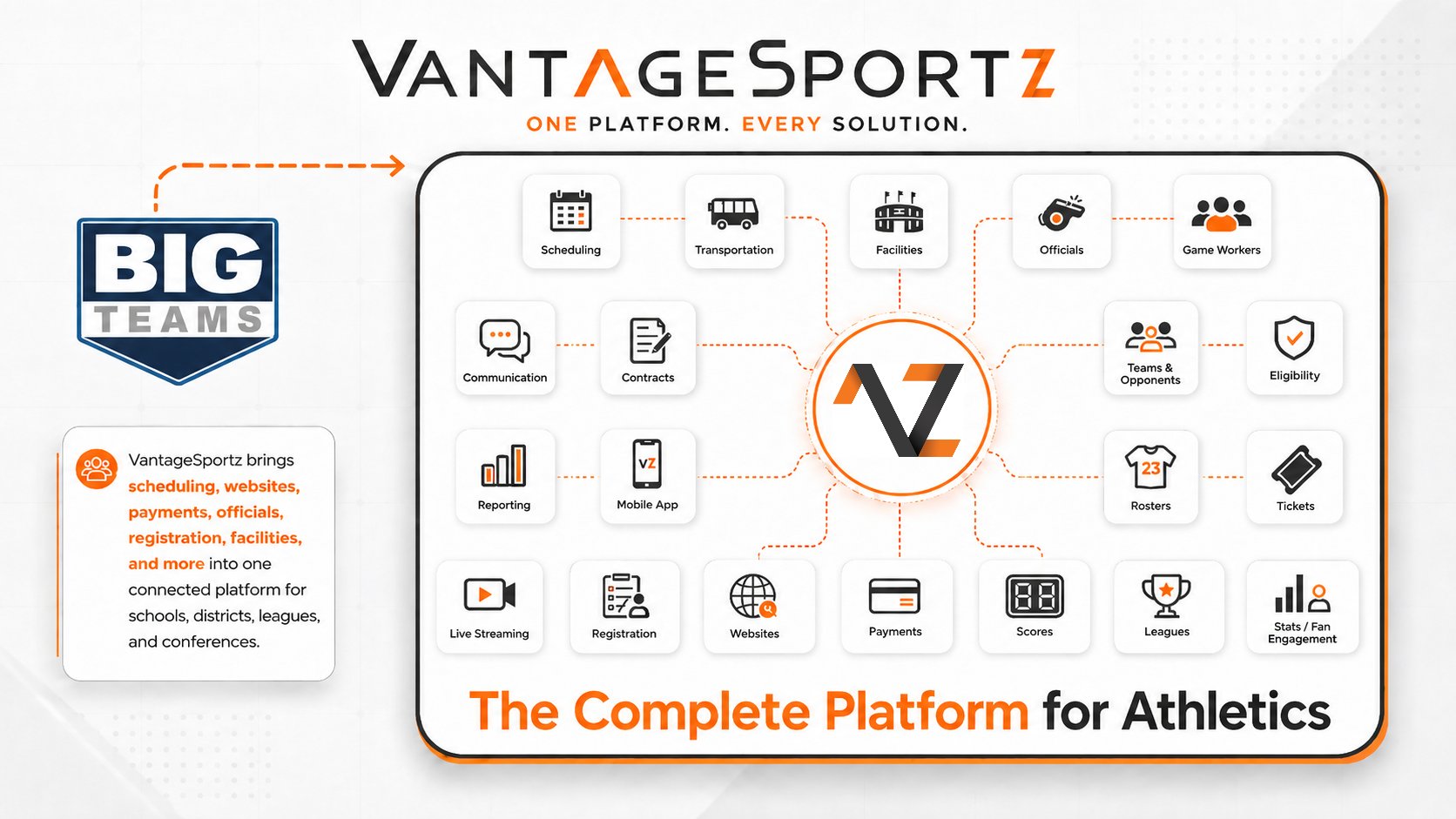
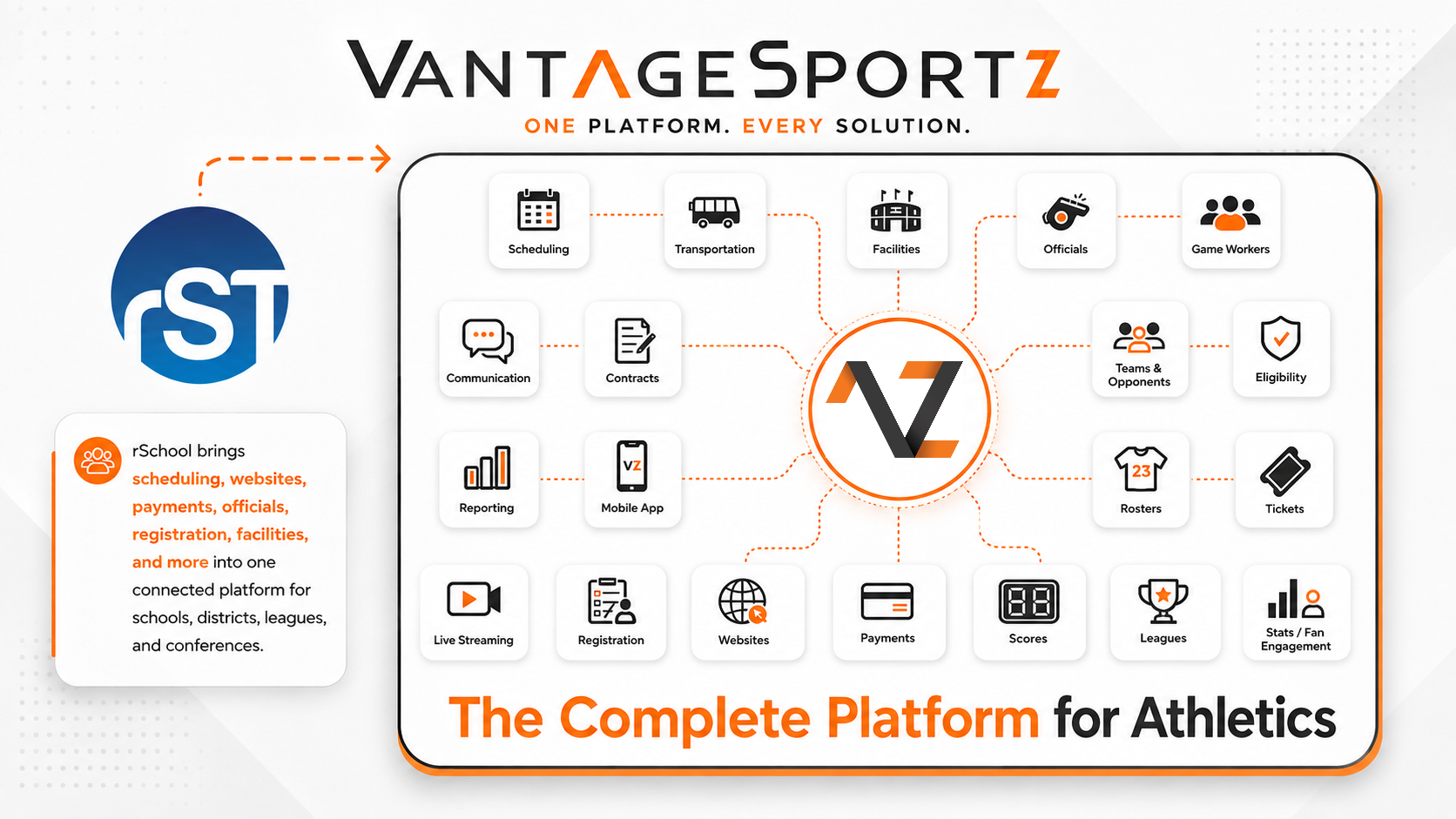
VantageSportz provides technology across school athletics and activities, including activity scheduling, facility scheduling, registration, officials management, payments, and school websites.
Its facilities scheduling solution, powered by Alphacility, is designed specifically around the way K–12 schools and districts manage shared spaces.
Rather than treating facility scheduling as another isolated calendar, Alphacility provides a centralized environment for facility requests, availability, approvals, bookings, community rentals, payments, space information, and reporting.
How Alphacility Simplifies Facility Scheduling for Schools
Alphacility is built to replace the scattered processes many schools still use to manage their facilities.
Staff and approved groups can submit facility requests through a consistent online process. Administrators gain real-time visibility into facility availability and can use district-defined approval workflows to determine how requests move through the organization.
Because reservations are managed centrally, schools have clearer visibility into how gyms, fields, classrooms, auditoriums, cafeterias, and other spaces are being used.
Community rentals can also be managed through the same environment, helping schools coordinate outside facility use with internal schedules while managing rental payments and cost recovery.
And when questions arise later, administrators have historical information tied to the request instead of having to reconstruct the decision from memory.
For a single school, that can mean fewer scheduling conflicts and less administrative work.
For a district, it can mean a consistent process across multiple buildings with centralized visibility into facility usage.
Learn more about Alphacility and how VantageSportz helps schools and districts centralize facility scheduling.
Is Facility Scheduling Software Right for Your School?
Not every school needs to replace its current process tomorrow.
If your facilities are easy to coordinate, requests rarely conflict, community use is limited, and everyone consistently works from the same calendar, the existing process may still be doing its job.
The warning signs usually appear as scheduling demand increases.
Staff begin spending more time checking availability. Community requests become harder to coordinate. The same scheduling conflicts happen repeatedly. Approvals become difficult to track. Administrators start maintaining additional spreadsheets simply to understand information that already exists somewhere else.
At that point, the issue is no longer the occasional scheduling mistake.
The process itself has become difficult to manage.
A dedicated school facility scheduling system creates structure around that process so administrators can spend less time reconciling calendars and more time managing how facilities are actually used.
A Better Way to Manage School Facilities
School facilities are some of a district’s most valuable and heavily used resources.
They support instruction, athletics, activities, community programs, performances, meetings, and countless events throughout the year.
Managing those spaces effectively requires more than an open square on a calendar.
Schools need to know whether a space is available, who requested it, whether the request was approved, what the event requires, and how that reservation affects everyone else using the building.
That is what facility scheduling software for schools is designed to provide.
With one centralized process for requests, approvals, scheduling, rentals, payments, and facility visibility, schools can reduce administrative work while making shared spaces easier to manage.
If spreadsheets, paper forms, disconnected calendars, and email chains are becoming harder to maintain, it may be time for a more organized approach.
Explore Alphacility facility scheduling software for schools and districts or learn more about VantageSportz Facilities Scheduling.